Here is an explanation about so called "the Bataan Death March." However, it wasn't 100km but only 60km walk. Japanese planed to move POW by trucks, but unexpected number of American soldiers were surrendered right away.https://t.co/93QInfzbDI
— lulu_happy4@通知が来ない、返信ツイートが見えないケースが増えました (@lulu_happy4) November 24, 2020
わたしの反論例 文法とか話がわかりづらい部分とか、後々問題点を改善していきたいとおもっています。
Here is an explanation about so called “the Bataan Death March.” However, it wasn’t 100km but only 60km walk. Japanese planed to move POW by trucks, but unexpected number of American soldiers were surrendered right away.
It was only happened because MacArthur and the military brass have fled to Australia!! Sneaky American army had destroyed tanks and trucks in an attempt to get in the way of the Japanese army. So they had to walk. In a sense, they brought it on themselves.
Do you believe the American propaganda of 80 years ago? After months of fighting with the Japanese, surrounded and exhausted American soldiers suffering from malaria and typhus were taken as prisoners of war and made to walk about 60 kilometers (about 37 miles) to the camp?
The Japanese military also walked a long way. With equipment equipment of tens of kilometers. American troops came empty-handed. The American troops were holed up in their operational plans and were running out of food,
which weakened their immunity and caused them to contract malaria and typhus. The poor Japanese, feeling sorry for them, took a break, gave them water to drink, and even gave them their own food to eat, but what was the “death march”?
Isn’t that propaganda made by the escaped MacArthur? This is the history of humanitarianism. Who is to blame for this? The Chinese Nationalist army would shoot all the prisoners of war on the spot. #BataanDeathMarch#WW2Propaganda
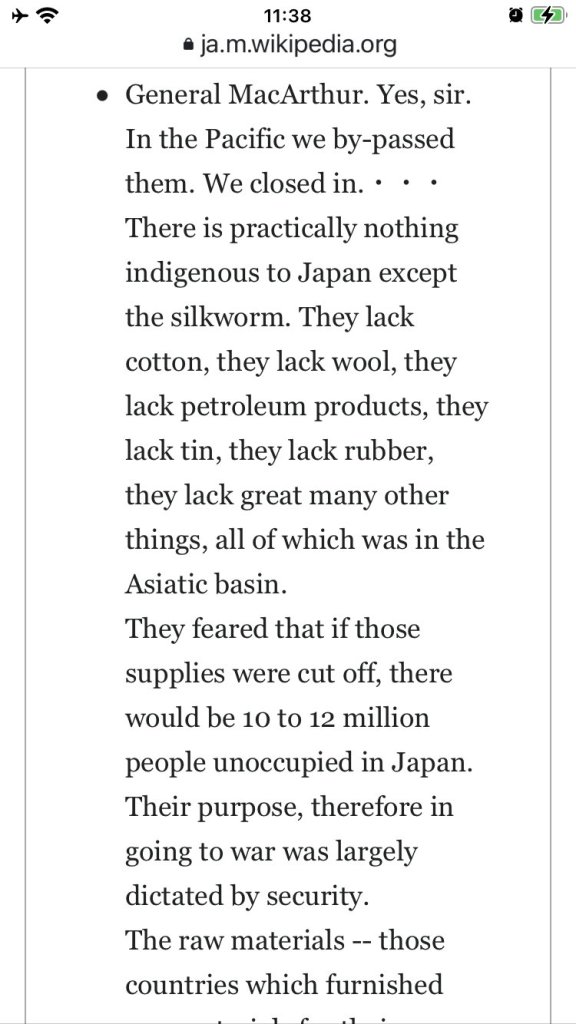
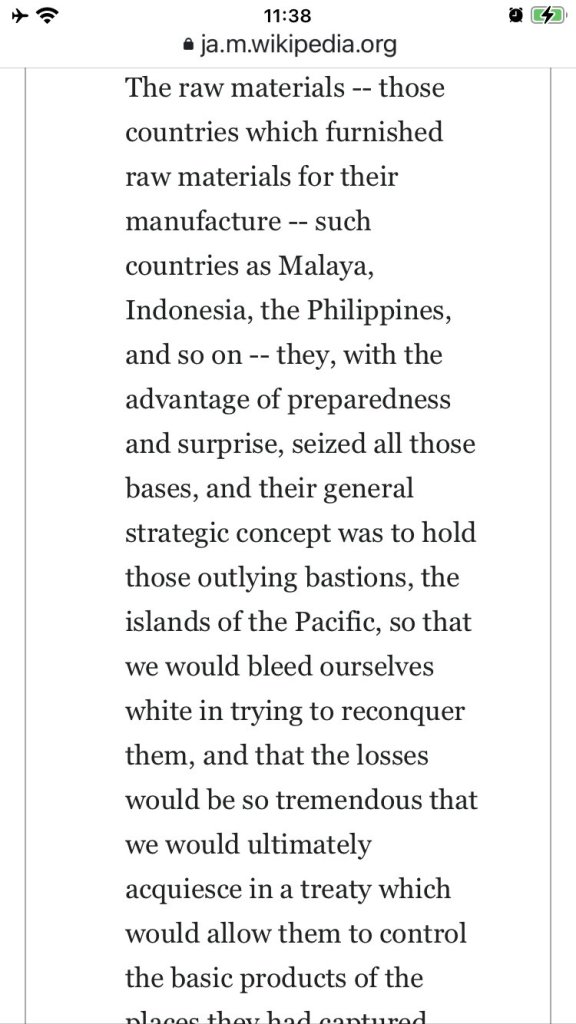
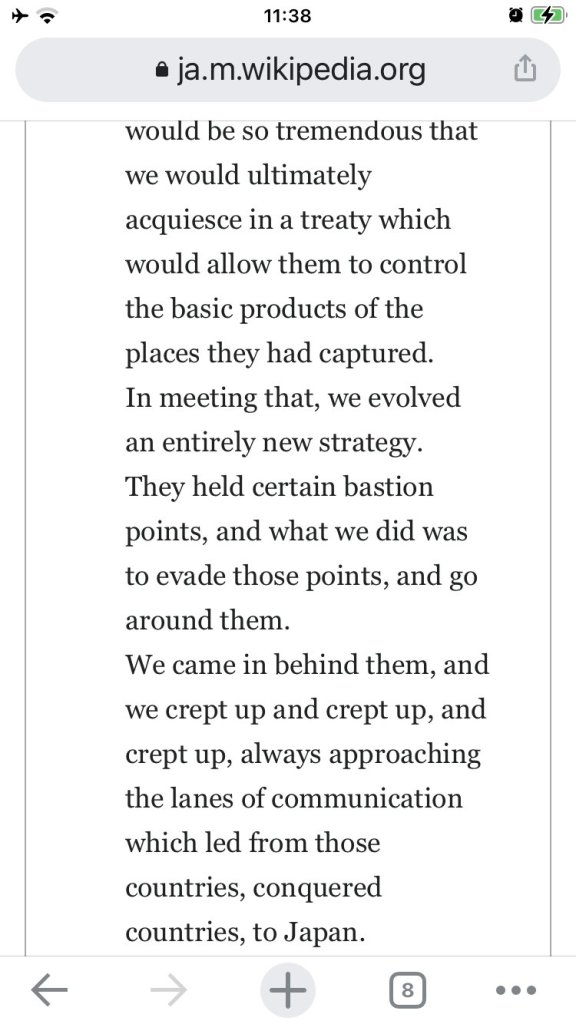
BTW, do you know General MacArthur said these after stayed and understand what was WW2. At the same age, Chinese KMT army moved to Chongqing which was over 2100 miles. Do American soldiers think 37miles is too long to walk?
It was forced to be escorted on foot, causing many prisoners to die in the process and being called the Bataan Death March.
In those days Japanese Army didn't have enough trucks and food for them. Japanese soldiers also walked to Bataan. We have to take all things into considerations when we talk about a case. Your comment is based on one- sided view of victorious nations.
In reference to the Agreement concluded by us today on behalf of our respective Governments, I have the honour to inform you that the British Government recognizes that the naval forces of Great Britain should, so far as possible, act in concert with those of Japan in time of peace, and agrees that mutual facilities shall be given for the docking and coaling of vessels of war of one country in the ports of the other, as well as other advantages conducing to the welfare and efficacy of the respective navies of the two Powers.
At the present moment Great Britain and Japan are each of them maintaining in the Extreme East a naval force superior in strength to that of any third Power. Great Britain has no intention of relaxing her efforts to maintain, so far as may be possible, available for concentration in the waters of the Extreme East, a naval force superior to that of any third Power.
I have the honour to be, with the highest consideration,
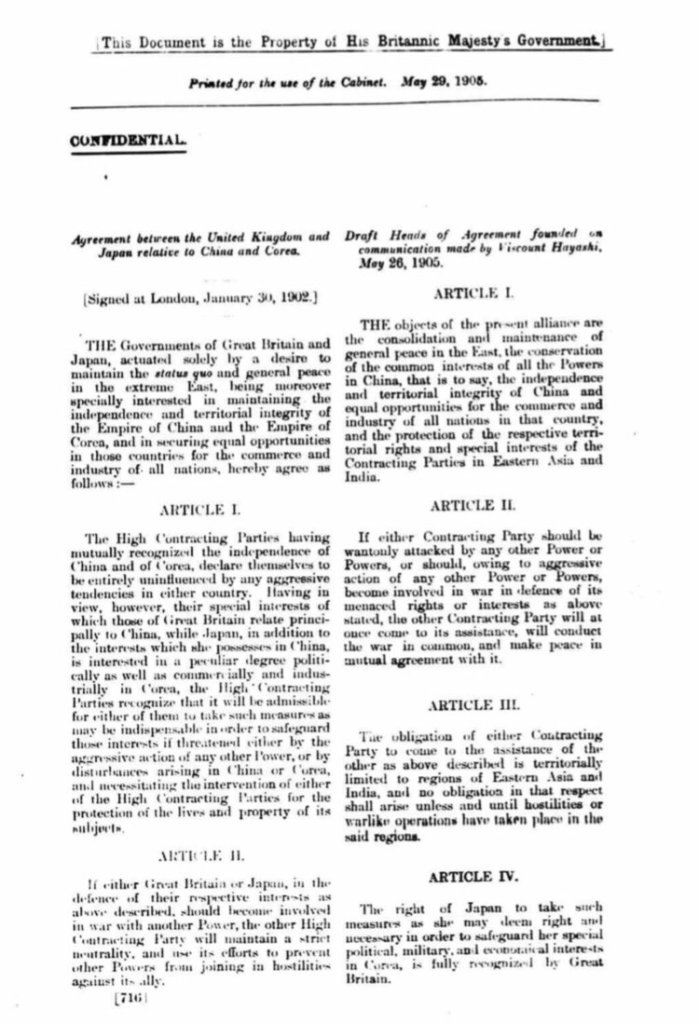
[Title] AGREEMENT OF ALLIANCE OF 1902.(Agreement of Alliance between Japan and Great Britain, 1902, First Anglo-Japanese Alliance)[Place] LONDON
[Date] January 30, 1902
[Source] Kyujoyakuisan, Dai 1 kan, Dai 2 bu, pp.168-170.
[Notes][Full text]
Signed at London, in English, January 30, 1902 (35th year of Meiji).
Published February 12, 1902.
The Governments of Japan and Great Britain actuated solely by a desire to maintain the status quo and general peace in the Extreme East, being moreover specially interested in maintaining the independence and territorial integrity of the Empire of China and the Empire of Corea, and in securing equal opportunities in those countries for the commerce and industry of all nations hereby agree as follows:–
ARTICLE I.
The High Contracting Parties having mutually recognized the independence of China and of Corea declare themselves to be entirely uninfluenced by any aggressive tendencies in either country. Having in view, however, their special interests; of which those of Great Britain relate principally to China, while Japan in addition to the interests which she possesses in China is interested in a peculiar degree, politically as well as commercially and industrially, in Corea, the High Contracting Parties recognize that it will be admissible for either of them to take such measures as may be indispensable in order to safeguard those interests, if threatened either by the aggressive action of any other Power or by disturbances arising in China or Corea and necessitating the intervention of either of the High Contracting Parties for the protection of the lives and property of its Subjects.
ARTICLE II.
If either Japan or Great Britain, in the defence of their respective interests as above described, should become involved in war with another Power, the other High Contracting Party will maintain a strict neutrality and use its efforts to prevent other Powers from joining in hostilities against its Ally.
ARTICLE III.
If in the above event any other Power or Powers should join in hostilities against that Ally, the other High Contracting Party will come to its assistance and will conduct the war in common and make peace in mutual agreement with it.
ARTICLE IV.
The High Contracting Parties agree that either of them will, without consulting the other, enter into separate arrangements with another Power to the prejudice of the interests above described.
ARTICLE V.
Whenever, in the opinion of either Japan or Great Britain, the above mentioned interests are in jeopardy, the two Governments will communicate with one another fully and frankly.
ARTICLE VI.
The present Agreement shall come into effect immediately after the date of its signature and remain in force for five years from that date. In case neither of the High Contracting Parties should have notified twelve months before the expiration of the said five years the intention of terminating it, it shall remain binding until the expiration of one year from the day on which either of the High Contracting Parties shall have denounced it, but if when the date fixed for its expiration arrives either Ally is actually engaged in war the Alliance shall, ipso facto, continue until peace is concluded.In faith whereof the undersigned duly authorized by their respective Governments have signed this Agreement, and have affixed thereto their seals.Done in duplicate in London, the 30th January, 1902.[L.S.] (Signed) HAYASHI,Envoy Extraordinary and Minister Plenipotentiary of His Majesty the Emperor of Japan at the Court of St. James.[L.S.] (Signed) LANSDOWNE,His Britannic Majesty’s Principal Secretary of State for Foreign Affairs.
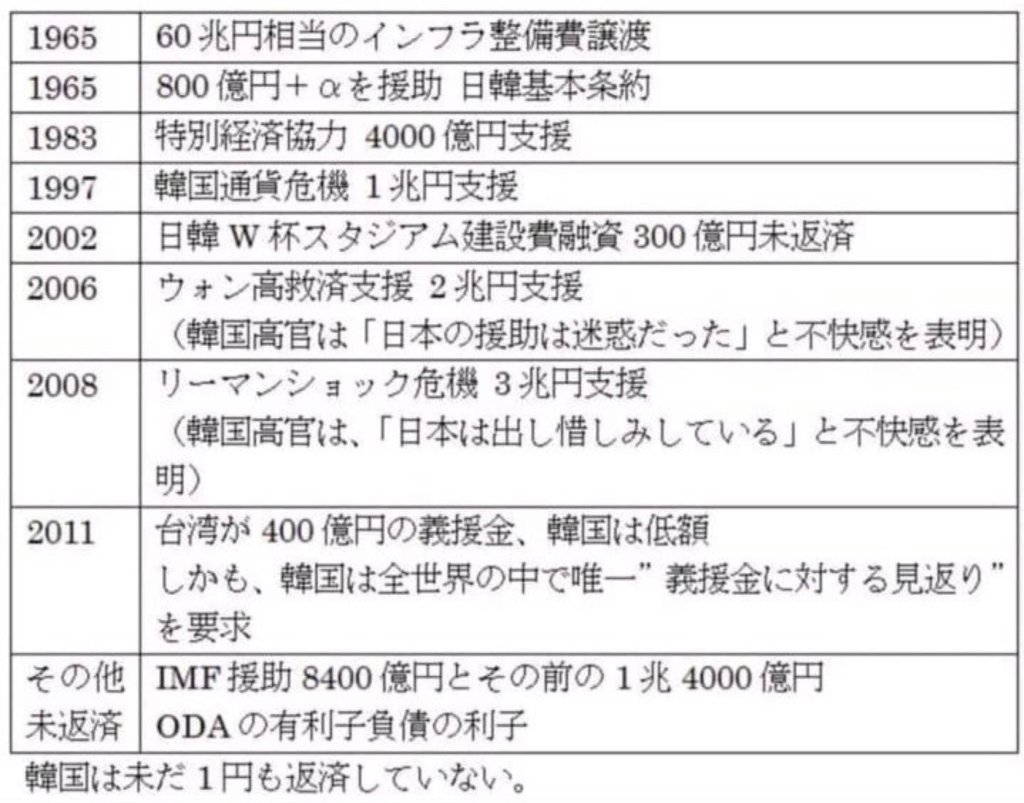
ROK is about to break the 1965 Japan-ROK’s Basic Treaty. If it does, it should repay all the assets left by Japan (60 trillion yen), unpaid wages and compensation to wartime workers and various other economic cooperation costs paid by the Japanese government to the ROK government.
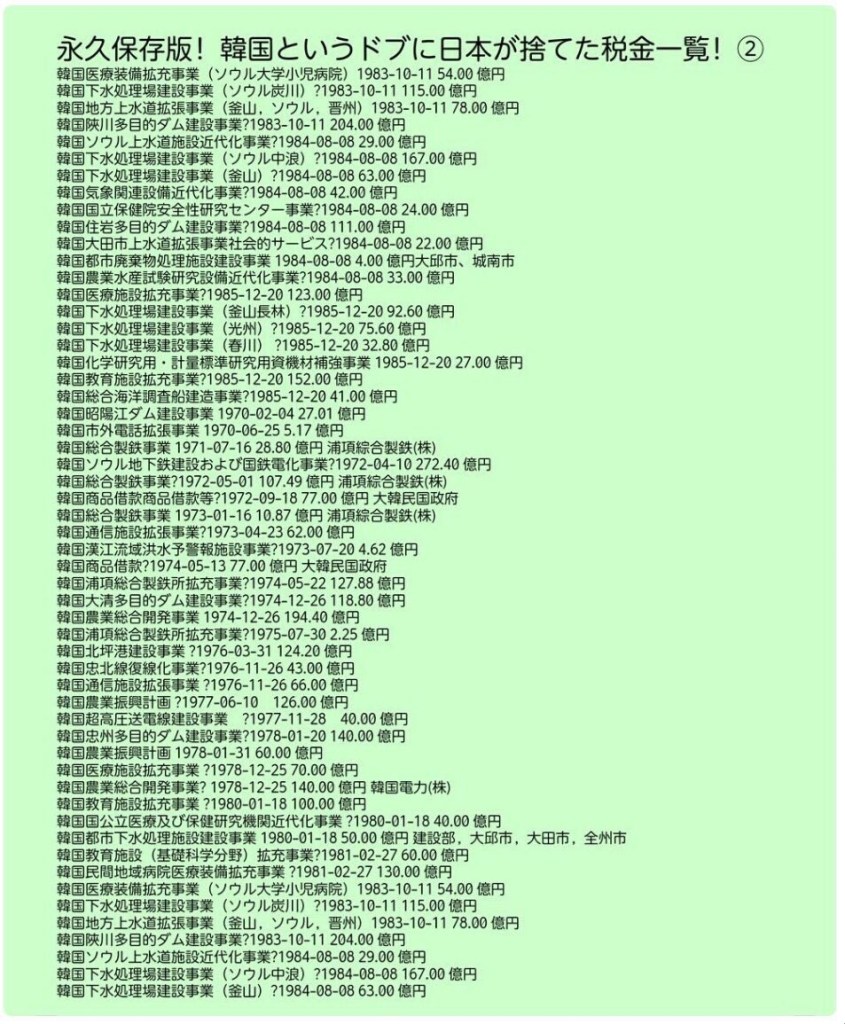
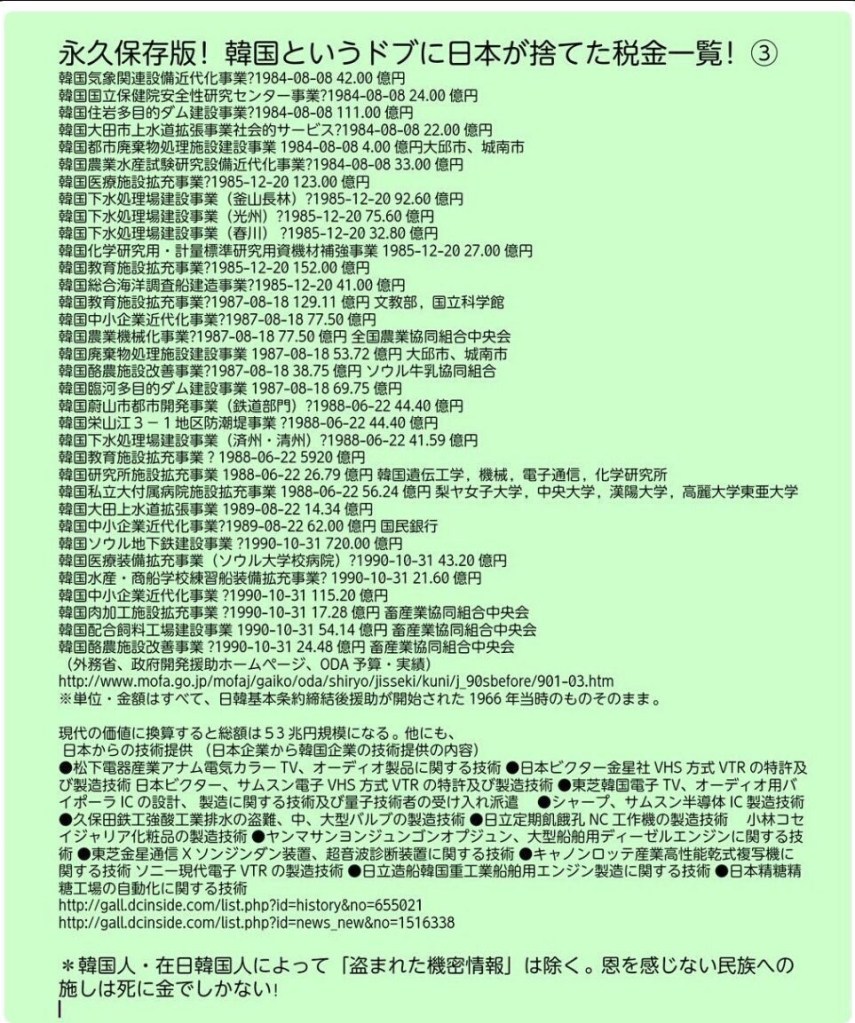
So how much money Japan has been giving to S.Korea at the time, let’s translate the chart above. 1965: 60 trillion yen worth of infrastructure transfers (the Netherlands and the UK billed Indonesia and India respectively) 1965: ¥80 billion plus aid to Japan-Korea Basic Treaty.
1983: Special Economic Cooperation, ¥400 billion 1997: SK currency crisis 1 trillion yen in aid 2002: Japan-Korea World Cup stadium construction loan of 30 billion yen not yet repaid.
2006: The SK economic crisis of Won’s appreciation against other currency, SK government aid of 2 trillion yen (South Korean officials expressed displeasure, saying that Japan’s aid was a nuisance.
2008: The Lehman crisis: ¥3 trillion in aid (South Korean officials expressed displeasure that Japan was being stingy with its aid.
2011: Taiwan donates 40 billion yen for the Great East Japan Earthquake, while South Korea donates a low amount. Furthermore, South Korea is the only country in the world to request a “quid pro quo” for its donation. Other Interest on ODA’s interest-bearing debt.
S.Korea has yet to repay a penny. Moreover, Japan did many other financial aids to SK government. In 1965, Korea’s national budget was 350 million dollars. Combined with the infrastructure left behind, the total was $17.5 billion. Of course, Japan did not have to pay that much.
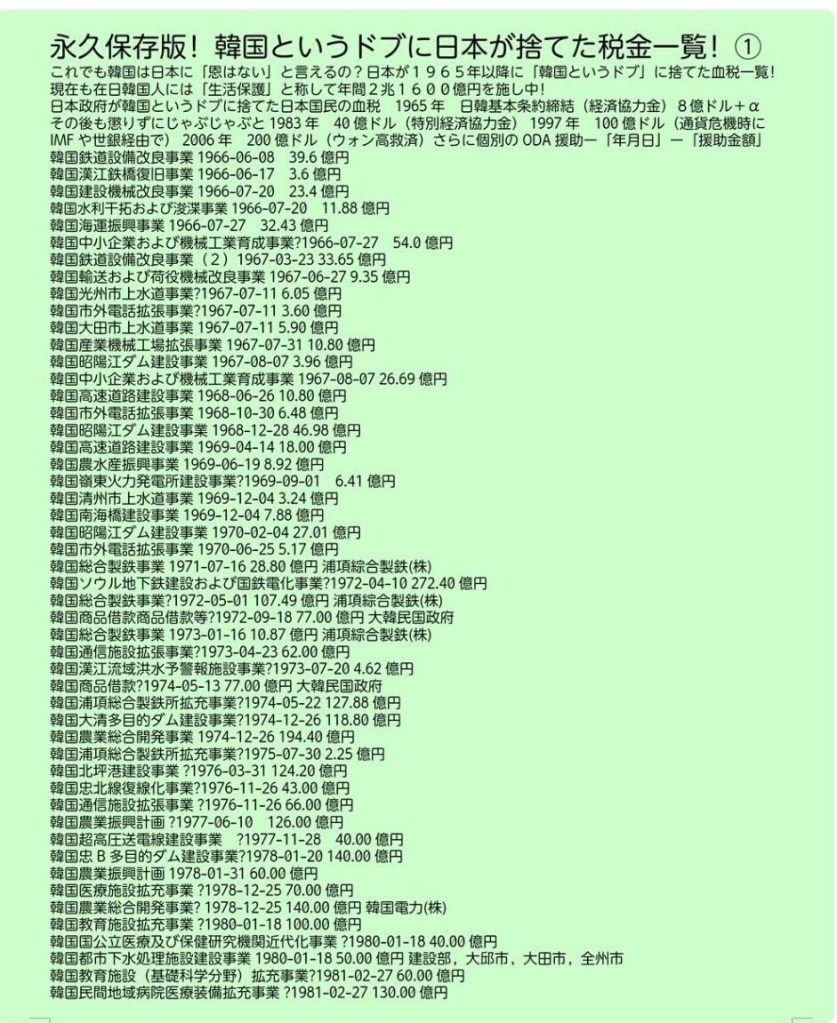
Here is another the list of a small size projects beside above. These Japanese government subsidies to South Korea are not included in the above 17.5 billion USD. The sum of this projects are also huge. I would like to adding up and show the value of these projects near future.
South Korea drew the “Rhee Seung-man Line” on the high seas in 1952, illegally capturing and taking thousands of Japanese fishermen and abusing them in detention centers and prisons in Busan. SK took over #TAKESHIMA.
The Japanese capitulated to South Korea’s aggressive “hostage-taking” and surrendered civilian assets under the Japan-South Korea Agreement, promising a total of US$500 million (US$300 million for free and US$200 million for compensation),
The US government, under the Clinton and Bush administrations, spent 7 years and 30 million dollars to look into Japanese war crimes. Out of millions of pages of newly declassified material, they were unable to find evidence of forced prostitution by Japanese military.
The US government, under the Clinton and Bush administrations, spent 7 years and 30 million dollars to look into Japanese war crimes. Out of millions of pages of newly declassified material, they were unable to find evidence of forced prostitution by Japanese military.
The final IWG report to Congress was issued in 2007. https://archives.gov/files/iwg/reports/final-report-2007.pdf… The many contemporaneous records of the allied forces at the end of the war clearly identify comfort women as contract prostitutes.
Here’s a compilation of primary source documents, mostly WWII military records of U.S., Allied, Dutch, Australian and Japanese reports and documents, which provides a true description of the comfort women system based on primary source documents.
The following are the lists of comfort stations in China & SE Asia where Korean women worked. The comfort stations were all owned and operated by Korean brothel operators. The Japanese military did not operate comfort stations. The Japanese and Korean soldiers were the customers.
Some Korean operators continued the business even after WW2, and many women were forced into prostitution during the Korean war. “They say we walked into gijichon on our own, but we were cheated by job-placement agencies and were held in debt to pimps”
”One Million Comfort Women and Hostess Tested Under VD Eradicate Policy But eradication of VD seems impossible due to shortages of budget, medicine, and facilities.” The Dong-a Ilbo Jan.15.1955
”The Reality of War-damaged Women becoming Prostitutes
Almost all of 1,274 comfort women for UN soldiers registered to 289 pimps became comfort women due to poor living conditions.” The Kyunghyang sinmum Feb.25.1952
”They(Korean government) URGED us to sell as much as possible to the G.I.’s PRAISING us as ‘Dollar-earning Patriots‘” Ms. Kim said” The New York Times [Jan.07.2009]
An old woman who was operating a comfort woman business for UN servicemen lured five virgins, including 15-year-old girl with promises of getting them jobs in the Military Hospital.” The Dong-a Ilbo Jul.21.1953
”An Evil Pimp Arrested” A whore house operator told a 21-year-old woman that she would pay her debt of 30,000 hwan if she would work for one month as a comfort woman, but when she could no longer endure the suffering and tried to escape, she was illegally confined and beaten numerous times. The Kyunghyang sinmum Jul.14.1954
”Four Country Virgins Lured And Sold as Comfort Women
They were deceived by being told they could get a job in Seoul, and sold to US brothels as comfort women by two female brokers.” The Dong-a Ilbo Feb.18.1963





![Wartime Military Records on Comfort Women by [Archie Miyamoto]](https://m.media-amazon.com/images/I/61IcuEGPP0L.jpg)



 日本を守ろう